

Table of Contents
Introduction
The way people watch television has changed forever. An iptv service — short for Internet Protocol Television service — delivers live channels, sports, movies, and on-demand content directly over your internet connection, replacing the cables, satellite dishes, and expensive contracts that once defined home entertainment.
Millions of households around the world have already made the switch, and millions more are evaluating their options right now. The appeal is straightforward: an iptv service typically costs a fraction of a traditional cable subscription, works on every device you already own, requires no technician visit to install, and gives you access to a far broader selection of content than any cable package ever could.
But not all platforms are built the same. The market ranges from polished, professionally operated providers to unstable, poorly supported services that disappear without warning. Knowing what separates a genuinely good iptv service from a disappointing one — and understanding how to evaluate, set up, and optimize your subscription — is what this guide is all about.
By the end, you will have a clear framework for choosing the right iptv service for your household, setting it up correctly, and getting consistent, high-quality performance from day one.
Users should comply with local laws and licensing regulations when selecting any streaming platform. Content availability may vary by region. Always use only authorized content sources.

What Is an IPTV Service and How Does It Work?
An iptv service delivers television content using the same internet infrastructure that powers websites, video calls, and cloud storage. Instead of broadcasting a signal through cables or satellites, content is encoded into digital data packets and streamed to your device on demand.
Here is how the process works in practice:
- Encoding: Live TV signals and stored video files are compressed into digital formats — most commonly H.264 or the more efficient H.265 (HEVC)
- Hosting: The encoded streams are stored and managed on remote servers maintained by the provider
- Request and delivery: When you select a channel or video, your device sends a request to the server, which begins streaming the content to you in real time
- Playback: Your IPTV app decodes the incoming data stream and displays it on your screen
This architecture gives any quality iptv service significant advantages over traditional broadcasting. Providers can offer thousands of channels simultaneously, update their content libraries without any hardware changes, and serve subscribers anywhere in the world from the same infrastructure.
The Three Core Content Types
A full-featured iptv service typically delivers three categories of content:
- Live TV: Real-time channel broadcasts — news, sports, entertainment — streamed exactly as they air
- Video on Demand (VOD): A library of movies, series, documentaries, and specials available to watch at any time
- Time-Shift / Catch-Up TV: The ability to rewind or replay recently aired broadcasts, so you never miss content because of scheduling conflicts
Premium platforms integrate all three into a single seamless interface, making the experience feel as natural and intuitive as any traditional cable setup.
Why More Households Are Choosing an IPTV Service
The mass migration away from cable toward iptv service platforms is driven by a combination of economic, technological, and lifestyle factors that show no sign of reversing.
Dramatic Cost Savings
A standard cable or satellite subscription — including equipment rental, installation fees, and mandatory bundled channels — can easily exceed $100 to $150 per month in many markets. A quality iptv service subscription typically costs between $15 and $50 per month, depending on the provider and the number of simultaneous connections included. For a household that watches television regularly, the annual savings can run into the hundreds or even thousands of dollars.
Freedom From Long-Term Contracts
Cable companies have historically locked customers into 12 or 24-month contracts with significant early termination fees. Most iptv service providers operate on flexible monthly billing, allowing subscribers to cancel, upgrade, or switch providers at any time without financial penalty. This freedom fundamentally changes the relationship between consumer and provider — quality must be earned every month.
Device Flexibility
An iptv service works on virtually every screen in your home. Smart TVs, smartphones, tablets, laptops, desktop computers, Amazon Fire Sticks, Android TV boxes, and streaming devices like Roku and Chromecast are all compatible with leading platforms. A single subscription can follow you from the living room television to your bedroom tablet to your phone during a commute — something no cable subscription can offer.
Unmatched Content Breadth
Even the most generous cable package has limits — fixed channel lineups, restricted international content, and premium add-ons for sports or movies. A well-curated iptv service can include tens of thousands of channels from dozens of countries, hundreds of international languages, dedicated sports packages, and VOD libraries with tens of thousands of titles. For multicultural households or viewers with international content preferences, this is a transformative difference.
Key Features That Define a Quality IPTV Service
Understanding what separates an excellent iptv service from a mediocre one requires knowing which features actually matter in everyday use.
Stream Stability and Uptime
Consistency is the most important quality of any iptv service. A platform that streams beautifully at 2 AM but buffers constantly during prime-time evenings or major live events is not genuinely reliable. Look for providers that:
- Maintain multiple redundant server locations to handle traffic spikes
- Explicitly guarantee high uptime percentages
- Offer anti-freeze and anti-buffer technology on their streams
- Have a proven track record of performance during peak periods like sporting finals or holiday programming
The only reliable way to verify this is through a trial period — which any reputable iptv service should offer.
Stream Resolution and Quality
The best iptv service platforms offer channels in Full HD (1080p) and increasingly in 4K Ultra HD. Resolution matters, but encoding quality matters equally. A high-bitrate 1080p stream encoded with H.265 will look noticeably better than a low-bitrate stream of the same resolution, especially on large screens or during fast-motion content like live sports.
Ask providers about:
- Available resolutions (SD, HD, FHD, 4K)
- Encoding standards used
- Average bitrates for HD channels
Channel Volume and Variety
A large channel count is only valuable if those channels are relevant to you. A quality iptv service should offer strong coverage in the content categories that matter most to your household:
- Local and national news channels in your country and language
- Entertainment networks across multiple genres
- Sports channels including live coverage of major leagues and events
- International content for multilingual households
- Children’s programming if you have young viewers at home
- Documentary and educational channels for variety
Always request or review a full channel list before subscribing, rather than relying on a headline number like “10,000+ channels.”
Electronic Program Guide Integration
A functional Electronic Program Guide — EPG — is what transforms a basic stream list into a true television replacement. The EPG displays current and upcoming programming information for every channel, allows you to browse schedules hours in advance, and in some players enables recording or reminder functionality.
An iptv service that does not provide reliable EPG data forces you to guess what is currently airing, which degrades the viewing experience significantly compared to traditional cable. Make EPG availability a firm requirement in your evaluation process.
Video on Demand Library
A strong VOD library extends the value of an iptv service well beyond live television. Look for:
- A large, regularly updated movie library spanning multiple genres
- Full series availability with organized season and episode browsing
- Recent releases updated on a reasonable schedule
- Search and filter functionality to find content quickly
Multi-Connection Support
Most households have more than one viewer. A quality iptv service should offer multi-connection plans that allow two, three, or more devices to stream simultaneously under a single subscription. Verify the number of concurrent streams your plan includes and whether additional connections can be added affordably.
Customer Support Responsiveness
The quality of support tells you a great deal about how professionally an iptv service is operated. Legitimate providers offer multiple support channels — live chat, email ticketing, or a detailed knowledge base — and respond within a reasonable timeframe. A service that provides no visible support contact, or that goes offline when subscribers have problems, is a significant red flag regardless of how impressive its channel count may appear.
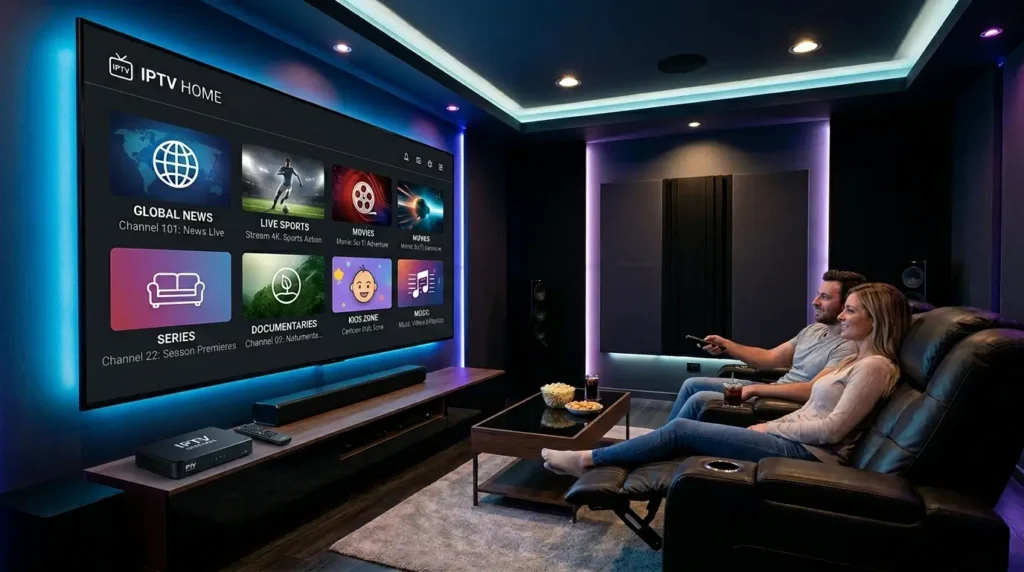
How to Evaluate an IPTV Service Before Subscribing
Choosing an iptv service without testing it first is a mistake that wastes both time and money. Follow this evaluation framework before committing to any subscription.
Request a trial period. Every trustworthy iptv service offers a free or low-cost trial period — typically 24 to 48 hours. This window is your opportunity to evaluate real-world performance under your actual conditions: your internet connection, your devices, and your content preferences.
Test during peak hours. Stream quality during off-peak hours tells you almost nothing about peak performance. Test on a weekday evening and during a weekend afternoon or live sports broadcast to understand how the service handles high-traffic periods.
Verify your must-have channels. Do not assume a channel is included because the provider’s marketing is vague. Confirm every channel that matters to your household — local news, specific sports networks, international channels — is actually available and streams reliably.
Evaluate the EPG. Load the program guide and confirm it displays accurate, up-to-date schedule data for the channels you plan to watch most frequently.
Test across all your devices. If you plan to watch on a living room smart TV, a bedroom Fire Stick, and an iPhone, test all three during the trial period. Compatibility issues are far easier to resolve before you have paid for a full subscription.
Contact support during the trial. Send a test question to the support team and measure both response time and the quality of the answer. This gives you a realistic preview of the support experience you can expect as a paying subscriber.
Setting Up an IPTV Service: Step-by-Step Guide
Once you have selected your iptv service, the setup process is typically quick and straightforward.
Step 1 — Choose Your Media Player
Most iptv service providers supply credentials rather than hardware. You will need a compatible media player app to use them. Widely used options include:
- TiviMate — premium Android TV and Fire Stick player with excellent EPG support and a polished interface
- IPTV Smarters Pro — cross-platform app available on Android, iOS, and Smart TV
- GSE Smart IPTV — feature-rich option popular on iOS and Android
- Kodi with PVR IPTV Simple Client — open-source, highly customizable for advanced users
- VLC Media Player — free universal player suitable for testing M3U playlists
Step 2 — Collect Your Credentials
After subscribing, your iptv service provider will supply:
- Username and password
- Server URL or M3U playlist link
- EPG URL (for program guide data)
Step 3 — Configure the Player
Open your chosen app and navigate to the playlist or account section. Enter your server URL or M3U link along with your username and password. The app connects to the provider’s servers and downloads your channel list automatically.
Step 4 — Set Up the Program Guide
Enter your EPG URL in the program guide settings of your player. Allow the app to download and parse the schedule data — this may take a few minutes on the first load.
Step 5 — Organize Your Channel List
Create a favourites list with your most-watched channels, hide or filter out categories you do not need, and organize your content library for efficient navigation. This step takes only a few minutes and pays dividends in daily usability.
Step 6 — Optimize Your Connection
For the best performance:
- Use a wired Ethernet connection instead of Wi-Fi wherever possible
- Ensure your router firmware is up to date
- Restart your router and streaming device before your first session
- If using Wi-Fi, position your device as close to the router as practical or use a mesh network node near your television
Internet Speed Requirements for an IPTV Service
Your internet connection is the single most important technical factor in your iptv service experience. Use this table as a reference:
| Content Quality | Minimum Speed | Recommended Speed |
|---|---|---|
| Standard Definition (SD) | 5 Mbps | 10 Mbps |
| HD (720p) | 10 Mbps | 20 Mbps |
| Full HD (1080p) | 15 Mbps | 25 Mbps |
| 4K Ultra HD | 25 Mbps | 50+ Mbps |
For households streaming on multiple devices simultaneously, multiply the recommended speed by the number of concurrent streams. Most modern broadband plans in developed markets comfortably support multiple simultaneous HD streams.
If you experience persistent buffering on a fast internet connection, the issue is likely Wi-Fi interference, router performance, or server-side congestion during peak hours. Contact your iptv service provider’s support team with details about when buffering occurs and on which devices.
Frequently Asked Questions About IPTV Service
Q: Is an iptv service legal? IPTV technology is fully legal. The legality of any specific iptv service depends on whether the content it delivers is properly licensed. Always select services that operate within applicable broadcasting regulations and use authorized content sources.
Q: What is the difference between an iptv service and regular streaming platforms? Traditional streaming platforms like subscription video services typically offer on-demand libraries only. An iptv service combines live television channels, VOD libraries, and catch-up TV in a single subscription — much closer to a full cable replacement.
Q: Can I use an iptv service on a smart TV without a streaming device? Many modern smart TVs running Android TV, Google TV, or Tizen support IPTV player apps directly. Check your television’s app store for compatible players before purchasing additional hardware.
Q: How many channels does a typical iptv service include? Reputable providers typically offer anywhere from 5,000 to over 20,000 channels, depending on the subscription tier. Channel count alone is not a reliable quality indicator — focus on the specific channels and content categories you actually need.
Q: What should I do if my iptv service stops working? First, check your internet connection and restart your streaming device. If the problem persists, log into your provider’s support portal or contact their support team. Most outages affecting multiple subscribers are resolved within hours by professional providers.
Q: Can I record content with an iptv service? Some media players support recording functionality when used with an iptv service, allowing you to save live streams to local storage. This depends on both your player app and whether your provider permits recording. Check both before relying on this feature.
Getting the Most From Your IPTV Service
A few practical habits will ensure you consistently get the best possible performance from your subscription:
- Restart your streaming device weekly to clear cached data and refresh the connection
- Update apps regularly to benefit from performance improvements and stability fixes
- Use quality hardware — an underpowered streaming stick will struggle with 4K or high-bitrate HD streams regardless of your internet speed
- Monitor your internet speed periodically to confirm your ISP is delivering the performance you are paying for
- Take advantage of VOD during off-peak hours for the smoothest possible playback on bandwidth-intensive content
Conclusion: Choosing the Right IPTV Service for Your Household
An iptv service is no longer a niche alternative for technology enthusiasts — it is a mainstream, practical choice for any household looking to reduce entertainment costs without sacrificing content quality or variety. The combination of flexible pricing, device freedom, broad content selection, and the absence of long-term contracts makes the iptv service model genuinely superior to traditional cable for the vast majority of everyday viewers.
The investment of time in properly evaluating, setting up, and optimizing your chosen iptv service pays off every month in a viewing experience that is both more affordable and more enjoyable than anything a cable contract can deliver.
Take advantage of trial periods, test thoroughly, and choose a provider whose channel selection, stream quality, and customer support meet your household’s real needs. The right iptv service will quickly become an indispensable part of your home entertainment setup — and you will wonder why you waited so long to make the switch.
Great content! Keep up the good work!