

Table of Contents
Introduction
Canada IPTV has become one of the most searched terms in the country’s digital entertainment space — and for good reason. Millions of Canadian households have already cut the cord, replacing expensive cable and satellite contracts with flexible, internet-based television solutions that cost a fraction of the price and offer far greater content variety.
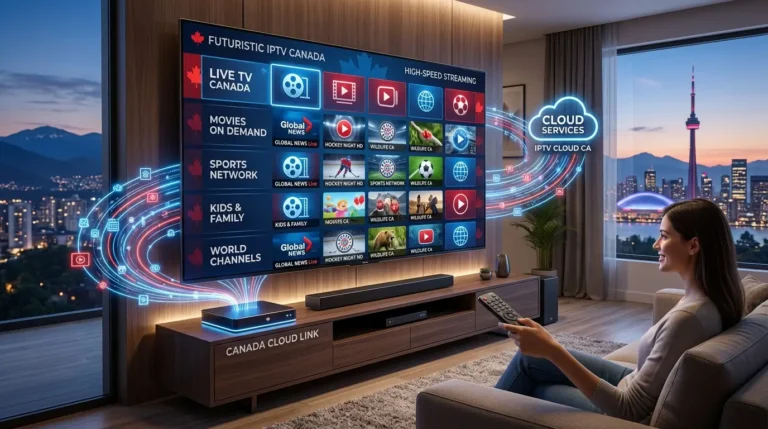
Internet Protocol Television, or IPTV, works by delivering live channels, video-on-demand libraries, and catch-up TV directly over your broadband connection. Instead of relying on coaxial cables or satellite dishes, everything arrives through your existing internet infrastructure. The result is a viewing experience that is more portable, more customizable, and more affordable than anything traditional broadcasting can offer.
Whether you live in a bustling city like Toronto or Vancouver, in suburban Quebec, or in a rural province underserved by major cable companies, canada iptv services open up a world of entertainment on every device you own. This guide covers everything — from how the technology works and what to look for in a provider, to setup instructions, troubleshooting tips, and answers to the most common questions Canadians ask before making the switch.
Users should comply with local laws and licensing regulations when selecting any streaming platform. Content availability may vary by region. Always choose only authorized content sources.

What Is Canada IPTV and How Does It Work?
At its core, canada iptv technology replaces the physical infrastructure of cable TV with a digital data stream. When you tune into a channel through a traditional cable provider, a signal travels through physical wires to a set-top box in your home. With IPTV, the same content is encoded into IP data packets and transmitted over the internet — just like a video call or a web page.
Here is a simplified breakdown of how the process works:
- Content encoding: Live TV signals and video files are encoded into compressed digital formats (H.264 or H.265 being the most common)
- Server delivery: The encoded content is hosted on remote servers maintained by your IPTV provider
- Streaming to your device: When you select a channel or video, your device sends a request to the server, which streams the content in real time
- Playback: Your IPTV app or media player decodes the stream and displays it on your screen
This architecture gives canada iptv providers remarkable flexibility. They can host thousands of channels simultaneously, update channel lists on the fly, and serve subscribers across the entire country from centralized infrastructure.
The two main delivery methods are:
- Live IPTV: Real-time channel broadcasts, identical to watching live cable TV
- Video on Demand (VOD): A library of movies, series, and past broadcasts you can watch at any time
Many premium services also include a time-shift or catch-up feature, allowing you to rewind live TV and watch recent broadcasts you may have missed — a feature traditional cable rarely offers without an additional fee.
Why Canadians Are Switching to Canada IPTV
The shift toward canada iptv is not just a trend driven by technology enthusiasts. It reflects a fundamental change in how ordinary Canadian families think about their entertainment spend.
The Cost Factor
The average Canadian household spent considerably more per year on traditional cable packages than on streaming alternatives. IPTV subscriptions in Canada typically run between $15 and $40 per month, depending on the package and number of connections. Compare that to standard cable bundles, which regularly exceed $100 per month when combined with equipment rental fees, installation charges, and mandatory channel packages full of content nobody watches.
Geographic Flexibility
Canada’s vast geography has always been a challenge for cable infrastructure. Rural communities in northern Ontario, the Prairies, British Columbia’s interior, and Atlantic Canada often have limited or no access to competitive cable providers. Canada IPTV eliminates this barrier entirely. As long as a household has a reliable broadband connection — including fixed wireless internet — they can access the same content as viewers in downtown Montreal or Calgary.
Multicultural Content Needs
Canada is one of the world’s most diverse nations, with large communities of recent immigrants and long-established multicultural populations. Portuguese, Hindi, Punjabi, Tagalog, Arabic, Mandarin, Cantonese — Canadians watch content in dozens of languages. Traditional cable rarely serves these needs affordably. A well-curated canada iptv platform can include hundreds of international channels across dozens of languages within a single subscription.
No Long-Term Commitments
Cable contracts often lock consumers into one or two year agreements with significant cancellation fees. Most canada iptv providers operate on a month-to-month basis, giving subscribers the freedom to cancel, upgrade, or switch at any time. This flexibility alone is enough to attract cost-conscious Canadian viewers who resent being held captive by their entertainment providers.
What to Look for in a Canada IPTV Service
Choosing the right canada iptv platform requires evaluating several key criteria. Not every service delivers what it promises, and the market includes both highly polished platforms and disappointing low-quality options.
Stream Quality and Resolution
The best canada iptv services offer channels in Full HD (1080p) and increasingly in 4K Ultra HD. Stream quality should be consistent — not just impressive during off-peak hours but reliable during busy evenings and weekend live events.
Look for providers that explicitly mention:
- H.265/HEVC encoding for efficient high-quality streams
- Anti-freeze and anti-buffer technology
- Multiple server locations to reduce latency for Canadian subscribers
Canadian Channel Coverage
A canada iptv service worth subscribing to must offer strong coverage of Canadian broadcasting. At minimum, look for:
- English national networks: CBC, CTV, Global, Citytv
- French-language networks: TVA, Radio-Canada, V Télé, Télé-Québec
- Regional Canadian channels: Local city stations, provincial news, regional sports
- Canadian specialty channels: TSN, Sportsnet, CP24, BNN Bloomberg
- APTN and other culturally significant Canadian broadcasters
If Canadian local content is important to you, confirm the channel list before subscribing — not all platforms that market themselves as canada iptv services carry the full suite of domestic channels.
International and Multilingual Content
For multicultural households, canada iptv offers an enormous advantage over cable. Premium providers offer content in South Asian languages, Chinese dialects, Arabic, Portuguese, Spanish, Tagalog, and many more. If this matters to your household, ask specifically about which international packages are included or available as add-ons.
Electronic Program Guide (EPG)
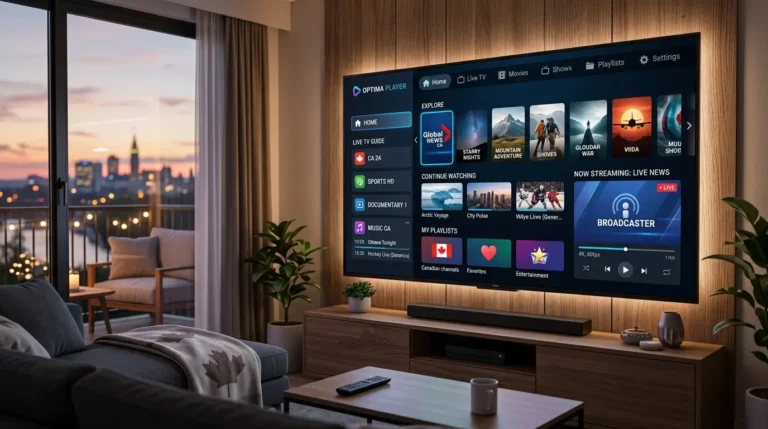
An Electronic Program Guide — the on-screen channel schedule — transforms the IPTV experience from basic streaming into something that genuinely replaces cable. A strong EPG integration lets you:
- See what is currently airing and what comes next
- Browse programming hours in advance
- Set reminders for upcoming shows
- Understand what you are watching at a glance
Services that do not offer EPG integration feel incomplete for everyday household use. Make this a non-negotiable requirement when evaluating canada iptv platforms.
Device Compatibility
Your subscription should work on every screen in your home. Leading canada iptv services support:
- Smart TVs: Samsung Tizen, LG webOS, Android TV, Google TV
- Streaming sticks: Amazon Fire Stick, Chromecast, Roku
- Mobile: Android and iOS smartphones and tablets
- Computers: Windows and macOS via web browser or desktop app
- Set-top boxes: Android boxes, MAG boxes, Apple TV (via compatible apps)
The more flexible the device support, the more value you extract from a single subscription.
Customer Support Quality
Responsive customer support is a signal of a professionally operated canada iptv service. Look for providers that offer live chat, email tickets, or support documentation covering common setup issues. A service that goes dark when you have a technical problem is not worth your monthly fee, no matter how impressive the channel count looks on paper.
How to Set Up Canada IPTV on Your Devices
Getting your canada iptv service running is a straightforward process once you have your subscription credentials. Here is a step-by-step walkthrough that works for most platforms.
Step 1 — Choose Your IPTV Player
Most canada iptv providers do not ship a hardware box — they give you access credentials that you use with a compatible media player app. Popular options include:
- TiviMate (Android TV, Fire Stick) — widely considered the gold standard for usability and EPG integration
- IPTV Smarters Pro (Android, iOS, Smart TV) — easy to use with a clean interface
- GSE Smart IPTV (iOS and Android) — flexible and feature-rich
- VLC Media Player (Windows, macOS, Android) — free, versatile, good for testing
Step 2 — Receive Your Subscription Credentials
After subscribing to a canada iptv service, you will typically receive:
- A username and password
- A server URL or M3U playlist link
- Optionally, an EPG URL for program guide data
Keep these credentials secure — they are what link your subscription to your devices.

Step 3 — Enter Your Credentials in the App
Open your chosen IPTV player and navigate to the add-account or playlist section. Enter the server URL (or M3U link), your username, and your password. The app will connect to the server and automatically download your channel list.
Step 4 — Configure Your EPG
If your provider supplies an EPG URL, enter it in the program guide settings of your player. The app will download schedule data and populate your channel grid with current and upcoming programming information.
Step 5 — Organize Your Channel List
Most IPTV players allow you to create favourites lists, hide unwanted channels, and reorder categories. Spend a few minutes organizing your channel list to match your viewing habits — this dramatically improves the day-to-day experience.
Step 6 — Test and Optimize
Stream a few channels across different categories — live news, sports, a movie from the VOD library. If you notice buffering:
- Switch from Wi-Fi to a wired Ethernet connection
- Restart your router
- Try a different server region if your provider offers multiple options
- Contact customer support to confirm your connection settings are correct
Internet Speed Requirements for Canada IPTV
Your broadband connection is the foundation of the entire canada iptv experience. Here are the minimum and recommended speeds for different quality levels:
| Stream Quality | Minimum Speed | Recommended Speed |
|---|---|---|
| Standard Definition (SD) | 5 Mbps | 10 Mbps |
| High Definition (HD 720p) | 10 Mbps | 20 Mbps |
| Full HD (1080p) | 15 Mbps | 25 Mbps |
| 4K Ultra HD | 25 Mbps | 50+ Mbps |
For households with multiple simultaneous streams — for example, one person watching a live sports channel while another watches a movie on a tablet — multiply these figures by the number of concurrent streams.
Most urban Canadian internet plans from major ISPs easily exceed these requirements. Rural and remote subscribers on slower DSL or satellite connections may need to select SD or 720p streams to maintain a buffer-free experience.
Canada IPTV for Sports Fans
One of the biggest draws of canada iptv for Canadian households is access to live sports content. Canadian viewers are passionate about hockey, football, basketball, soccer, and more — and traditional cable sports packages can add $20–$40 per month on top of already expensive base subscriptions.
A quality canada iptv service covers live sports programming across multiple categories. When evaluating sports coverage, look for:
- Dedicated sports channel categories
- Multiple simultaneous live game streams
- High-bitrate streams for fast-moving sports content (motion blur is a common complaint on low-quality streams)
- Reliable uptime during major events like playoff games or championship finals
Be aware that stream quality and availability during peak sports events is one of the most common complaints about lower-tier canada iptv providers. This is an area where testing during your trial period is especially important.
Frequently Asked Questions About Canada IPTV
Q: Is canada iptv legal? IPTV as a technology is completely legal in Canada. The legality depends entirely on whether the content provider holds proper licensing agreements. Always choose services that operate within Canadian broadcasting regulations and use only authorized content sources.
Q: Do I need a VPN for canada iptv? A VPN is not required to use most canada iptv services. However, some subscribers use VPNs to prevent ISP throttling of streaming traffic or to maintain privacy. If you use a VPN, confirm that your chosen canada iptv provider is compatible with VPN connections before subscribing.
Q: Can I use canada iptv when travelling abroad? Availability varies by provider. Some canada iptv services allow international access, while others restrict content by geographic region. Check with your provider before travelling if maintaining access is important to you.
Q: How many devices can use one canada iptv subscription? This depends entirely on your subscription plan. Single-connection plans are the most affordable but allow only one device to stream at a time. Most providers offer multi-connection plans for households with two, three, or more simultaneous viewers.
Q: What is the best device for canada iptv? Android-based devices offer the widest app compatibility and the most flexibility. Amazon Fire Stick 4K and Android TV boxes are popular choices for living room setups. For secondary screens, Android smartphones and tablets with a dedicated app deliver excellent performance.
Q: What happens if my canada iptv stream buffers constantly? Buffering is almost always caused by one of three factors: insufficient internet speed, Wi-Fi signal weakness, or server-side issues with your provider. Start by testing your internet speed, switch to a wired connection if possible, and contact your provider’s support team if problems persist.
Tips to Get the Best Performance from Canada IPTV
Maximizing your canada iptv experience goes beyond choosing the right service. Small technical adjustments can make a significant difference in daily viewing quality:
- Use Ethernet over Wi-Fi — A wired connection eliminates wireless interference and reduces latency
- Choose a device with sufficient processing power — Older or underpowered streaming sticks can struggle with HD streams; a modern Fire Stick 4K or Android box handles most streams effortlessly
- Keep firmware and apps updated — Updates frequently include performance improvements and stream stability fixes
- Restart devices weekly — Clearing cached data and resetting connections improves long-term performance
- Contact support early — If you experience issues in the first week, reach out to support before your trial ends so problems can be resolved or you can request a refund
Conclusion: Is Canada IPTV Right for You?
Canada IPTV represents a genuinely transformative shift in how Canadians consume television. The combination of lower monthly costs, broader content selection, device flexibility, and freedom from long-term contracts makes it an attractive alternative for virtually any household currently paying for cable or satellite service.
The key is choosing the right service. Test before you commit, prioritize providers with strong Canadian channel coverage and responsive support, and take the time to optimize your setup for the best possible performance. Once your canada iptv subscription is running smoothly, it is difficult to justify going back to the rigid, overpriced world of traditional broadcasting.
The future of Canadian television is streaming — and with the right platform, that future is already available in your living room today.


One thing I found useful in this guide is the emphasis on internet speed and proper EPG setup, since those details often have a bigger impact on the viewing experience than people expect. It would also be interesting to see a deeper comparison of how different household internet setups affect stream stability, especially for families watching multiple channels at the same time.